Friday, December 9, 2016

Jasper Johns

Jasper Johns


Jasper Johns is an American painter, sculptor and printmaker associated with Abstract expressionism, Neo-Dada, and Pop art according to Wikipedia. He was influenced by Robert RauschenbergPablo Picasso, and many others. 


Sculptures


"The Critic Smiles" (1959)


What's outstanding about this sculpture was that instead of sculpting the bristles on the toothbrush, John sculpted teeth. 


"The Critic Sees" (1961)

This sculpture surprised me. At first glance you just see a pair of glasses but at a closer inspection you see mouth for eyes. The critic sees through their mouth. 

You can already tell by looking at these sculptures that John didn't liked people criticizing his art without fully understanding the story behind it.  


"Light Bulb" (1960)
All I can say about this sculpture is that it seemed that John wanted or had new ideas, thoughts or inspiration. 

"Flash Light 1" (1958)


"Painted Bronze" (1960)


Fun Fact

"He never became, in historical terms, a mainstream artist, never joined the parade that sprang up after him in the early 1960s. He didn’t align his work with either Pop Art or Minimalism. And he certainly didn’t join any of the clubs associated with a style, technique or subject. Instead he went his own way and, more to the point, he exposed what he thought of critics in two sculptural objects, “The Critic Smiles” (1959), a well-known work depicting a toothbrush with human teeth instead of bristles, which is included in the exhibition at Craig F. Starr, and “The Critic Sees” (1961), which replaces the critic’s bespectacled eyes with a pair of mouths"- hyperallergic.com


"Sometimes I see it then paint it. Other times I paint it then see it...At every point in nature there is something to see."
-Jasper Johns

I like this quote from him. Describes me in terms when it comes to art. 


Friday, December 2, 2016

Assemblage

Assemblage Art


Assemblage is an artistic form or medium usually created on a defined substrate that consists of three-dimensional elements projecting out of or from the substrate. It is similar to collage, a two-dimensional medium--according to Wikipedia.


Artists Who Use Assemblage In Their Art


Jim Dine


Jim Dine is an American artist and poet known for his roles in both the formation of Conceptual Art “Happenings” and Pop Art.


Bedspring. 1960. Assemblage of oil, metallic paint, candles, metal candle holders, paper, corrugated cardboard, canvas, newsprint, waxed paper,


This assemblage makes me laugh for some reason. It's probably that face there, staring at you creepily. 

Robert Rauschenberg

Milton Ernest "Robert" Rauschenberg was an American painter and graphic artist whose early works anticipated the pop art movement. Rauschenberg is well known for his "Combines" of the 1950s, in which non-traditional materials and objects were employed in innovative combinations according to Wikipedia.

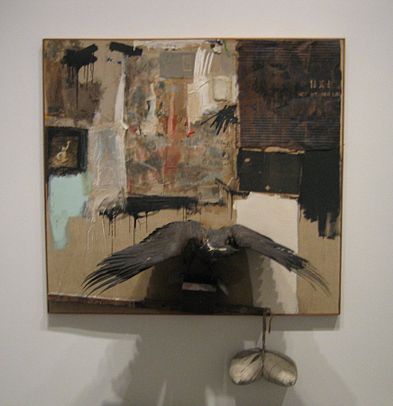
Canyon (1959)

The title of this assemblage says it all. It reminds me of a canyon. 


Kurt Schwitters

Kurt Schwitters was born in Germany in 1887. Originally concentrating on painting and poetry, he began experimenting with collages and assemblages.


Merzbild Rossfett (1919)

In my opinion this assemblage reminds me of an abandoned house or house that has been raided. It's sad now that you think of it. 


Niki de Saint Phalle

Niki de Saint Phalle was a French sculptor, painter, and filmmaker.


La Hachoir (1960)


This assemblage looks like someone is about to bake something. A person that comes to my mind is a housewife.

Portrait of My Lover (1961)


Interesting. I'm not sure if she hates her lover for leaving her because of the target for a head. This assemblage shows many emotions towards the lover of hers. 


Friday, October 28, 2016

Mayan Sculpture

Mayan Sculpture

The Mayan culture is a eastern and south eastern mesoamerican culture that took place in the time period of 500 BCE to 200 CE. The sculptures they've done all have different forms and functions. Some sculptures were made to represent the gods they worshiped. Others were made to make life easier, and some were just for decorations.


                                                                The Mayan Calendar


Tiquisate, Escuintla Incensario (Incense Burner) or cache vessel with woman holding cone


                                                                                    Replica of Rosalila Temple


Friday, October 14, 2016

Negative Space-

Negative Space


Negative Space is the space around and between the subject of an image. Some examples of negative are the following pictures:


Artists Who Uses Nagative Space


Michael Pippo 


 Uses negative space to illustrate that 'oh crap' moment from Brave. It was sold as a limited edition run of 300 screen-printed posters at San Diego Comic-Con 2012; sadly they've long sold out.


Tang Yau Hoong


Tang Yau Hoong is an artist, illustrator, graphic designer living in Kuala Lumpur, Malaysia. With a passion for creative thinking, he creates art that is conceptual, surreal and fun in a simplistic and unique way.

Suhki Barber


Negative space can also be used in 3D sculptures.


Friday, October 7, 2016

Tolga Girgin

Tolga Girgin


Tolga Girgin is an electronic engineer and also a calligraphist. Born in Simav, Kütahya, Turkey in 1981. He lives in Eskişehir, Turkey. He also does lettering and drawing. 


Why did I chose this artist? I chose Tolga Girgin because I think his calligraphy is incredible. I can't believe a human can make calligraphy in this type of way the way Tolga is doing. I never knew calligraphy and 3D together would come out looking like this to be honest. This is the first time I'm actually amazed by the artworks from others. 


What Tolga is dealing with in terms of materials and subject is doing illusions, combinations and texture. That's what I think he's thinking when drawing. 


Friday, September 30, 2016

Jake and Dinos Chapman

Jake and Dinos Chapman


    Iakovos "Jake" (born 1966) and Konstantinos "Dinos" (born 1962) are English visual artists, and are toften known as the Chapman Brothers. They're often recognize by their art with disfigured and molded together dolls masterpiece. 

Jake and Dinos Chapman below


 Zygotic 1997                                               


I've noticed that they make something that represents hell in everything, even the fast food industry. 


Their recent work seems different from their past works.

Who's Afraid Of Red, Black and White (Dipstick) 2016


I chose Jake and Dinos Chapman because of their weird creativity and their weird way of representing hell.


Friday, September 23, 2016

Japanese Masks

Japanese Masks


  Japanese culture has always fascinated me, but what I really didn't look into the Japanese culture was the Japanese masks you'll be seeing later on. If you know about masks, you should probably know that each mask has its own story and names. Each mask have different roles to play when they're put on. Here are the following Japanese masks; 


 Japanese mask is called "Otafuku". Otafuku is basically described as someone's happy grandma from the look on her face, I can see why. It's really a funny looking mask but at the same time it's warm and easy to get use to. People don't really know how she first appears but there's two theories how. According to this website, "According to one source Otafuku first appeared around the end of the Ashikgaga period (1392-1569) as the name of a miko named Kamejo (Tortoise Woman) at a certain Shinto Shrine, whose face resembled the traditional mask known as Okame (Tortoise).  She was devoted to the goddess Uzume no mikoto, and had a charming exuberance that seemed to radiate from her very being.  Despite her homely appearance, her sincerity and purity of spirit was such that even a villain of the most dastardly stripe would undergo a change of heart just by gazing at her face.  Because of this a mask resembling her was fashioned and given the name Otafuku (Much Good Fortune).  From the beginning the name Otafuku became known through the land.  However, there is another theory that Otafuku’s face was modelled after the goddess Uzume no mikoto." - 
/http://www.greenshinto.com/wp/2012/03/25/otafuku-and-uzume/


The Semimaru mask that represents happiness and serenity, in my opinion that is. It's the trype of mask you don't want to disturb its sleep. Semimaru actually represents the face of blind boy but the boy is also the son of an emperor. I like how ovalish the mask is and how smooth it looks, but I don't like how its eyes are closed, it could be a little open but then it would look like it's half asleep. This mask is used for the excursively for the play, "Semimaru."


The Hannya mask above is a mask used in Noh theater, representing a jealous female demon. It possesses two sharp bull-like horns, metallic eyes, and a leering mouth. In my opinion it's such a cool mask and could be used for Halloween probably. This mask has more features added to it and it doesn't look like it has any "flat" surfaces on it.


The Tanuki mask was used in Kyogen scene when hunting Tanuki. Tanuki is a Japanese raccoon dog. The mask looks like it has a smooth flat surface and to be honest, that kind of makes me want to touch it.


The Wakaonna mask is a mask representing a young lady. It was used by men if they had a female role in theater since women weren't allowed to perform. Kind of like the Otafuku mask in the beginning but much smoother and flat and also ovalish. The design is kind of funny too.